


 Home
HomeWhat Happens During a European Arrest Warrant Surrender from Ireland to Germany?

It started with a ping. In early 2026, a Schengen Information System (SIS) alert flagged a German national in Ireland. He was wanted for questioning back in Germany over the alleged removal of his child to Pakistan. His arrest triggered the European Arrest Warrant framework, and when he consented to his surrender, a very specific legal clock started ticking.
A European Arrest Warrant (EAW) surrender from Ireland to Germany isn’t a slow, drawn-out affair. It’s a judicial process on a tight schedule. Once a person consents to surrender, the Irish High Court has just 10 days to order it. Then, the clock resets. The physical transfer to Germany must happen within another 10 days of that court order. This rapid system deliberately replaces the older, much slower extradition politics between EU member states.
European Arrest Warrant (EAW) – A simplified cross-border judicial surrender procedure used between European Union member states. It allows a judicial authority in one country (the issuing state) to request the arrest and surrender of a person in another country (the executing state) for criminal prosecution or to serve a custodial sentence. It is based on the principle of mutual recognition.
Executing State – In this context, Ireland is the executing state. It is the EU member state responsible for receiving, reviewing, and carrying out the surrender request issued by another member state.
Issuing State – In this context, Germany is the issuing state. It is the EU member state whose judicial authority has issued the European Arrest Warrant to seek the return of an individual.
What is a European Arrest Warrant and Why Does It Exist?
The European Arrest Warrant is essentially a fast-pass for justice within the EU. It was designed to replace the sluggish and often political extradition treaties that existed before. The whole system is built on a simple but powerful idea: mutual recognition. Ireland, the executing state, fundamentally trusts the judicial decision made by Germany, the issuing state, and acts on it with minimal second-guessing.
This process is grounded in the Council Framework Decision 2002/584/JHA, an EU law mandating this rapid system and reflecting the deep trust member states place in one another’s legal frameworks. This isn’t a niche tool. In 2023 alone, judicial authorities across 26 member states issued a staggering 14,071 EAWs, proving its central role in modern cross-border justice.
On What Grounds Can Germany Issue an EAW for Someone in Ireland?
Germany can’t issue an EAW for just any reason. The request must relate to a serious offence, with specific thresholds for the potential sentence:
- For prosecution, the alleged offence must be punishable under German law by a prison term of at least 12 months.
- To enforce a sentence, the final custodial order must be for at least 4 months.
This ensures the EAW system is reserved for significant criminal matters, not minor infractions. The key factor is the potential sentence in Germany, regardless of what a similar crime might carry in Ireland.
For a specific list of 32 serious offences—think terrorism, drug trafficking, and murder—the process is even faster because the need to check if the act is also a crime in Ireland (dual criminality) is waived. For everything else, the Irish High Court can still review whether the act is a criminal offence under Irish law before ordering surrender. Navigating these details is precisely why people seek specialist knowledge in international arrest warrant defense.
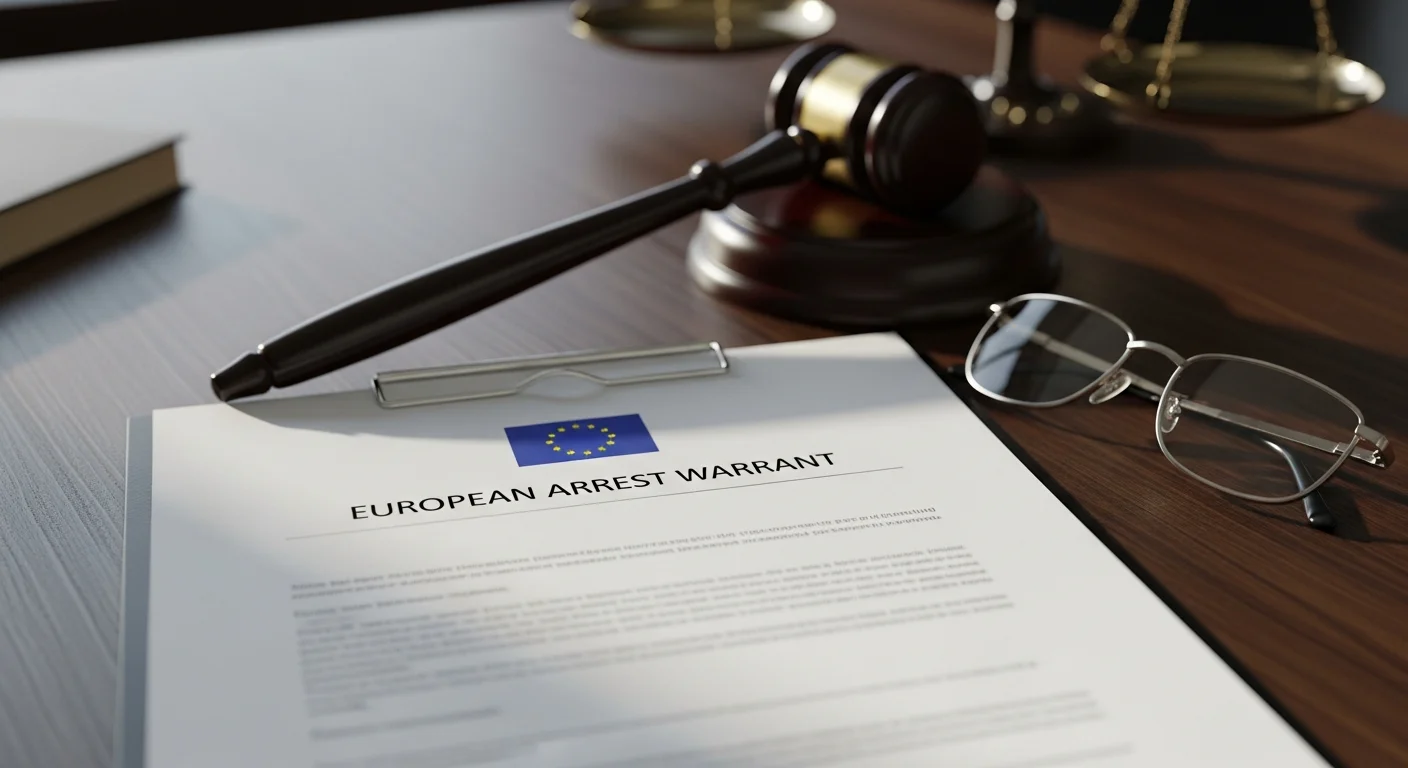
What is the Step-by-Step EAW Surrender Procedure in Ireland?
Ireland’s European Arrest Warrant Act 2003 governs the entire procedure. Once an EAW from Germany arrives, it’s sent to the Central Authority, a specialized unit inside the Department of Justice. From that point, a clear, time-sensitive process begins.
| Stage | Action | Typical Deadline | Legal Basis |
|---|---|---|---|
| 1. Endorsement | The German EAW is sent to the Irish Central Authority. An Garda Síochána (Irish Police) then applies to the High Court to endorse it, making it valid in Ireland. | Promptly upon receipt | European Arrest Warrant Act 2003 |
| 2. Arrest | With the High Court’s endorsement, Gardaí can arrest the person named in the warrant. A missed bail check-in or routine traffic stop could trigger this. | N/A | High Court Endorsement |
| 3. First Court Appearance | The arrested person must see a High Court judge as soon as practicable. Here, they’re told about the EAW and their rights, including the choice to consent to surrender. | Promptly after arrest | European Arrest Warrant Act 2003 |
| 4. Decision on Surrender | The High Court holds a full hearing to decide on surrender. This is the main battleground where legal arguments against surrender are made. | Within 60 days of arrest (can stretch to 90 days). | Article 17, Framework Decision 2002/584/JHA |
| 5. Expedited Decision (with consent) | If the person agrees to surrender, the final decision must happen fast—within 10 days of giving consent. This bypasses the full hearing. | 10 days from consent | Article 15, Framework Decision 2002/584/JHA |
| 6. Physical Surrender | Once a final order for surrender is made, authorities have just 10 days to physically transfer the person to the issuing state. | Within 10 days of the final order. | Article 23, Framework Decision 2002/584/JHA |
Takeaway: The process is built for speed. If you consent to surrender, the timeline compresses dramatically. You could go from arrest in Ireland to a plane to Germany in as little as 20 days.
What Are Your Rights if You Are Arrested in Ireland on an EAW?
Being arrested in Ireland on an EAW doesn’t suspend your rights. You are protected by a suite of fundamental, legally enforceable protections throughout the surrender procedure.
Your core rights include:
- The right to be clearly informed about what’s in the EAW and the crime you’re accused of.
- Access to a lawyer. This is non-negotiable.
- The right to an interpreter if you don’t speak or understand the language of the proceedings.
Crucially, the Irish High Court will refuse to order a surrender if it would breach your fundamental rights under the Irish Constitution or the European Convention on Human Rights. There are also mandatory reasons to refuse, like if you’ve already been tried for the exact same offence (the ne bis in idem principle).
What is the rule of specialty in an EAW?
The rule of specialty is a critical protection after you’ve been surrendered. It means that Germany can generally only prosecute or detain you for the specific offence written in the EAW. The German authorities cannot just add a list of new, unrelated charges once you arrive without going through a separate legal process.
Can I be extradited to a third country after EAW?
No, not without Ireland’s approval. Under Article 28 of the EAW Framework Decision, if you are surrendered from Ireland to Germany, you cannot be subsequently extradited to a third State (like Pakistan or any non-EU country) unless the Irish Central Authority at the Department of Justice agrees. This is a vital safeguard against being passed on to a country that may lack the EU’s legal protections, a key consideration for anyone exploring options in countries without extradition agreements.
What Happens to Time Spent in Custody in Ireland?
Any time spent in an Irish prison during the EAW process must count towards your final sentence. This isn’t a favour; it’s a right. The period of detention time you serve in Ireland while waiting for the surrender decision and transfer must be formally deducted from any sentence you receive in Germany.
This requirement is baked into both Article 26 of the EU Framework Decision and Ireland’s own European Arrest Warrant Act 2003. The rule ensures you aren’t penalized by administrative or legal delays. The Irish High Court officially records the exact number of days spent in detention and communicates this to the German judicial authorities, guaranteeing the credit is applied correctly to any subsequent sentence. It applies whether you were held pre-trial or were already serving a sentence. This entire process is part of a wider system covered in our comprehensive extradition and warrant guide.
⚠️ Time is critical — every day matters
Get a free case assessment
Our team specialises in cases with an international element. We review applicable treaties, assess risks, and prepare an action plan.
🔒 Confidential · Response within 24h · No obligation
Frequently Asked Questions
What is a European Arrest Warrant and Why Does It Exist?
The European Arrest Warrant is essentially a fast-pass for justice within the EU. It was designed to replace the sluggish and often political extradition treaties that existed before. The whole system is built on a simple but powerful idea: mutual recognition. Ireland, the executing state, fundamentally trusts the judicial decision made by Germany, the issuing state, and acts on it with minimal second-guessing.
On What Grounds Can Germany Issue an EAW for Someone in Ireland?
Germany can’t issue an EAW for just any reason. The request must relate to a serious offence, with specific thresholds for the potential sentence:
What is the Step-by-Step EAW Surrender Procedure in Ireland?
Ireland’s European Arrest Warrant Act 2003 governs the entire procedure. Once an EAW from Germany arrives, it’s sent to the Central Authority, a specialized unit inside the Department of Justice. From that point, a clear, time-sensitive process begins.
What Are Your Rights if You Are Arrested in Ireland on an EAW?
Being arrested in Ireland on an EAW doesn’t suspend your rights. You are protected by a suite of fundamental, legally enforceable protections throughout the surrender procedure.
What Happens to Time Spent in Custody in Ireland?
Any time spent in an Irish prison during the EAW process must count towards your final sentence. This isn’t a favour; it’s a right. The period of detention time you serve in Ireland while waiting for the surrender decision and transfer must be formally deducted from any sentence you receive in Germany.